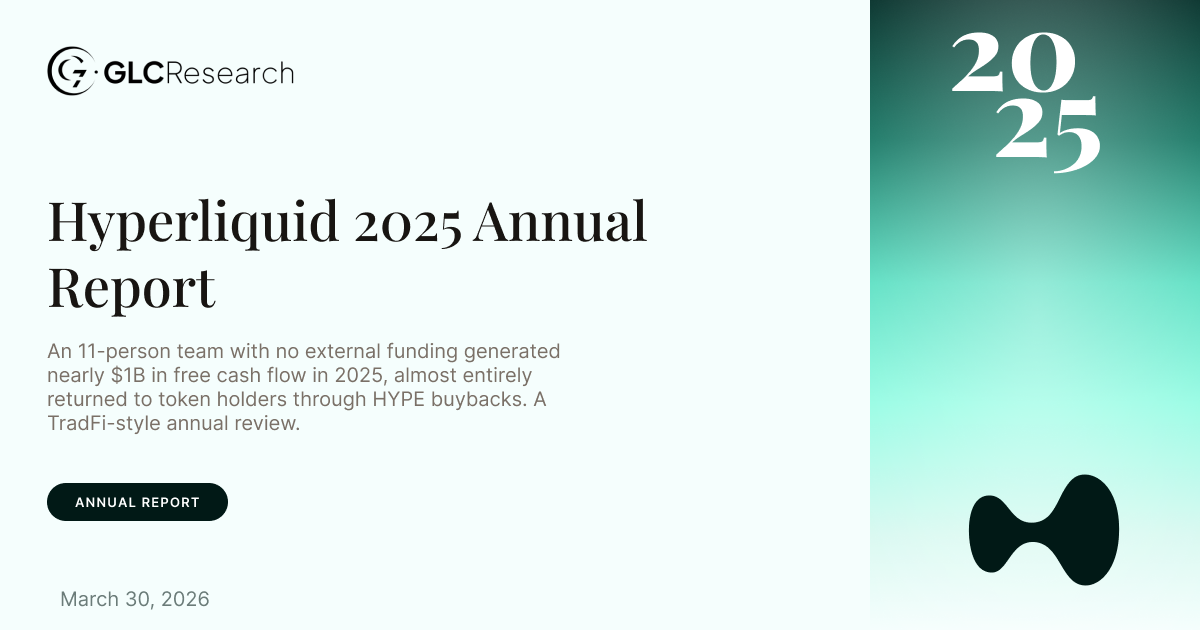
In 2025, Hyperliquid did something the financial industry had never quite seen before: an 11-person team, with no external funding, generated nearly $1 billion in free cash flow, almost entirely returned to token holders through open market HYPE buybacks.
Hyperliquid processed over $3 trillion in total trading volume, generating $907M in gross revenue. Perpetual derivatives drove 93% of that revenue, with the platform operating at an annualized run rate exceeding $1B based on H2 performance. Hyperliquid held over 50% of onchain perpetuals market share for most of the year, with open interest share more than doubling year over year.
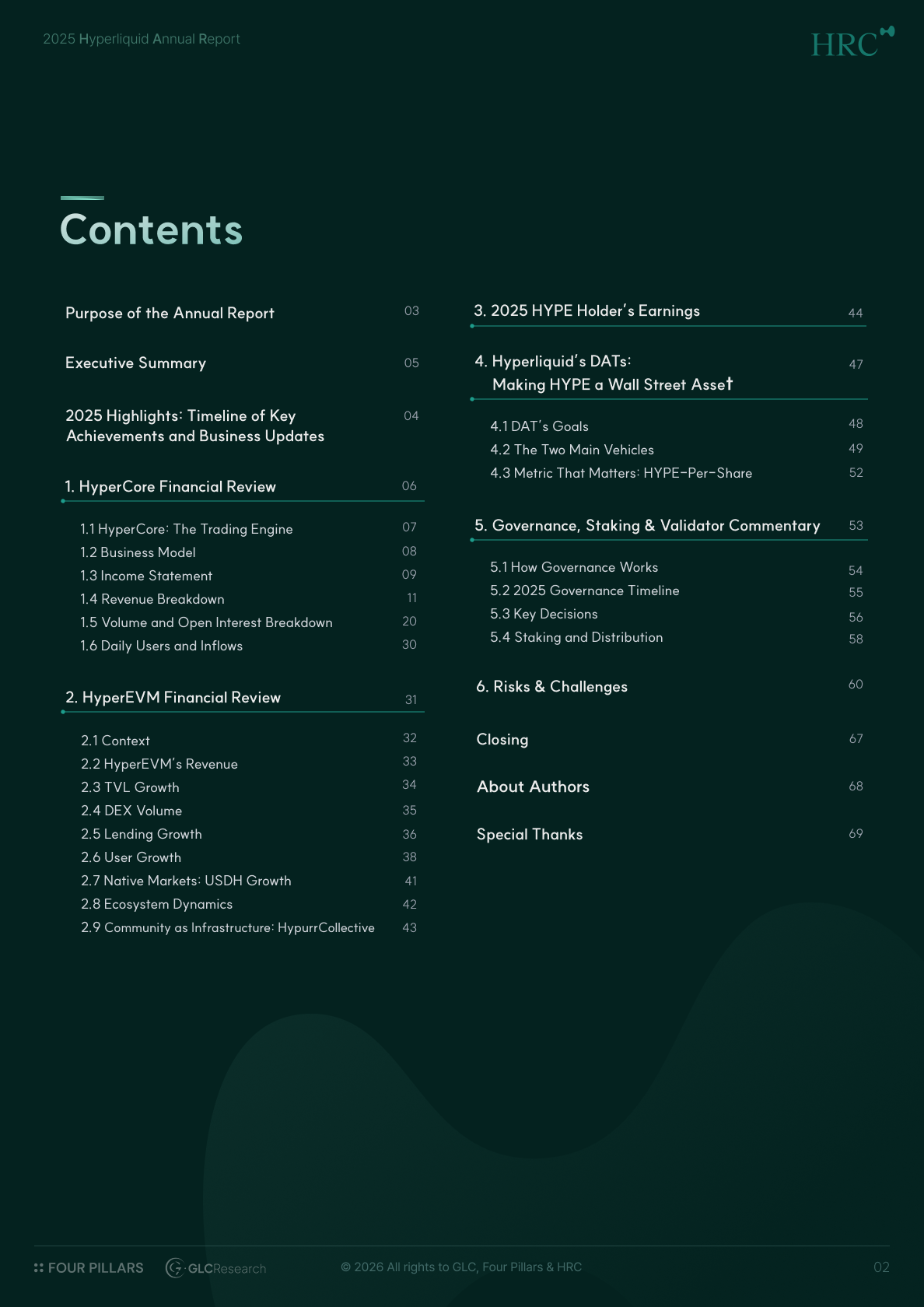
HyperEVM, launched in February, is the composability layer that sits alongside HyperCore, enabling lending protocols, yield strategies, structured products, and native stablecoins to operate within the same execution environment as the order book. Unlike most smart contract environments, HyperEVM drops builders directly into a live, mature exchange where utility is judged immediately — a brutal but honest filter that, by year end, had produced a focused ecosystem of protocols genuinely strengthening the core.
Unit/trade.xyz has been one of Hyperliquid's most important third-party contributors. Unit built the asset tokenization layer enabling native deposits of BTC, ETH, and SOL, making spot trading natively possible on Hyperliquid and unlocking strategies such as delta-neutral hedging and basis trading. Trade.xyz has since become the clear leader in equities and commodities through HIP-3, processing the majority of open interest across Silver, Gold, Nasdaq, and other real world asset markets.
HIP-3 transformed Hyperliquid from a single exchange into permissionless exchange infrastructure, with six deployers now live. Builder Codes reached 8% of total trading volume by Q4, generating $40M for third-party builders at near zero marginal cost to the protocol.
Regulatory clarity on permissionless perpetual derivatives remains the single largest variable ahead. The February 2026 launch of the Hyperliquid Policy Center reflects a deliberate strategy to shape that environment. HIP-3's expansion into real world assets is meanwhile reducing structural dependency on crypto market cycles.
What makes Hyperliquid genuinely unprecedented is harder to quantify than its numbers: a team that has consistently prioritized its users, its community, and its long term mission over short term extraction.
Views expressed are the authors' personal views and do not constitute investment advice. See our Disclaimer & Disclosure. © GLC Research.
![Trade[XYZ] 2026 Q2 Report](/assets/img/tradeXYZ 26Q2.png)